Record participation
Who does this: the participation officer at the AfCFTA Secretariat.
A participation record is ITS writing down a decision that has already been taken elsewhere. It says: this country takes part, from this date. That is all it does.
It does not create an account, send anyone an email, or let anybody sign in. What it does is unlock the possibility of them: until the record exists, an organisation cannot be created for that country.
Filing authority is recorded separately. If a Regional Economic Community will lodge declarations on behalf of a member country, that is its own record, with its own dates. A country can take part and file for itself, or take part and have its REC file for it. Those are two different records and they are kept apart deliberately.
The four states a record can be in
Every participation record and every filing arrangement carries a start date, and sometimes an end date. Those two dates decide which of four states it is in.
| State | What it means |
|---|---|
| Planned | The start date has not arrived. The record exists, but it grants nothing today. |
| Active | The start date has passed and no end date has been reached. This is the record in force. |
| Superseded | A later record replaced this one. It is kept so the history stays readable. |
| Withdrawn | The authority was removed. The record stays; the authority does not. |
The start date is the first day the authority applies. The end date is the last day it applies, not the day after. Leave the end date empty only when the decision itself was open-ended. Never enter a guess: a wrong end date silently stops a country filing on a day when it was entitled to.
These states are not the same as your organisation's state. A country can have an active participation record while its organisation is still REQUESTED, meaning known about but not yet admitted. Recording participation does not admit anybody — that is Admit the organisation.
Record that a country takes part
You need the approved decision and the dates it applies from, and if relevant to.
- Open Governance and choose the State Parties tab.
- Find the country. One with no record yet offers Record participation in the Actions column.
- Enter Effective from. Today's date means the country can file immediately.
- Leave Effective to open-ended unless an end date was actually agreed.
- Save.
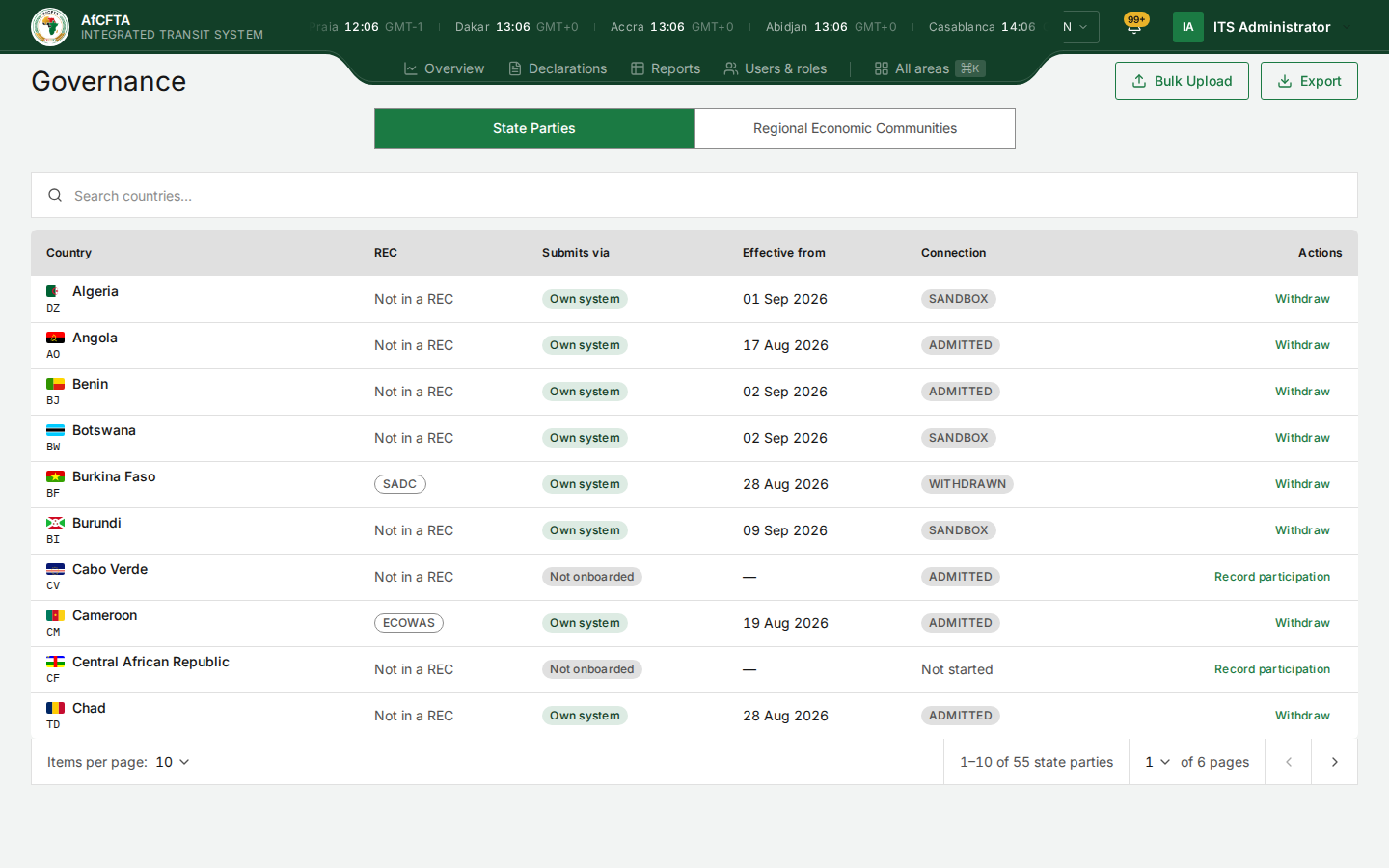
It worked when the country's row shows the date you entered and the Actions column no longer offers to record participation.
Read the Submits via column before anything else. "Own system" means the country files for itself; a REC name there means that community files on its behalf. Connection is a separate thing entirely — it tracks the technical account, not the participation.
If the country, the date or the state is wrong, correct it here before anyone is admitted. Do not use a technical admission later to paper over a governance record entered wrongly.
Record what a regional community files, and for whom
A regional community has two separate facts recorded about it: which countries belong to it, and which of those it actually lodges declarations for. They are not the same question, and membership alone grants nothing.
- Open Governance and choose the Regional Economic Communities tab.
- Choose Members & delegation for the community.
- Set the member countries. ITS offers the African Union's published membership as a starting point. It is a suggestion, not a decision — confirm it against what was agreed before saving.
- Set Submits for: all members including future ones, only the members you name, or nobody, because every member uses its own system.
- If you named members, list them under Delegated members.
- Save.
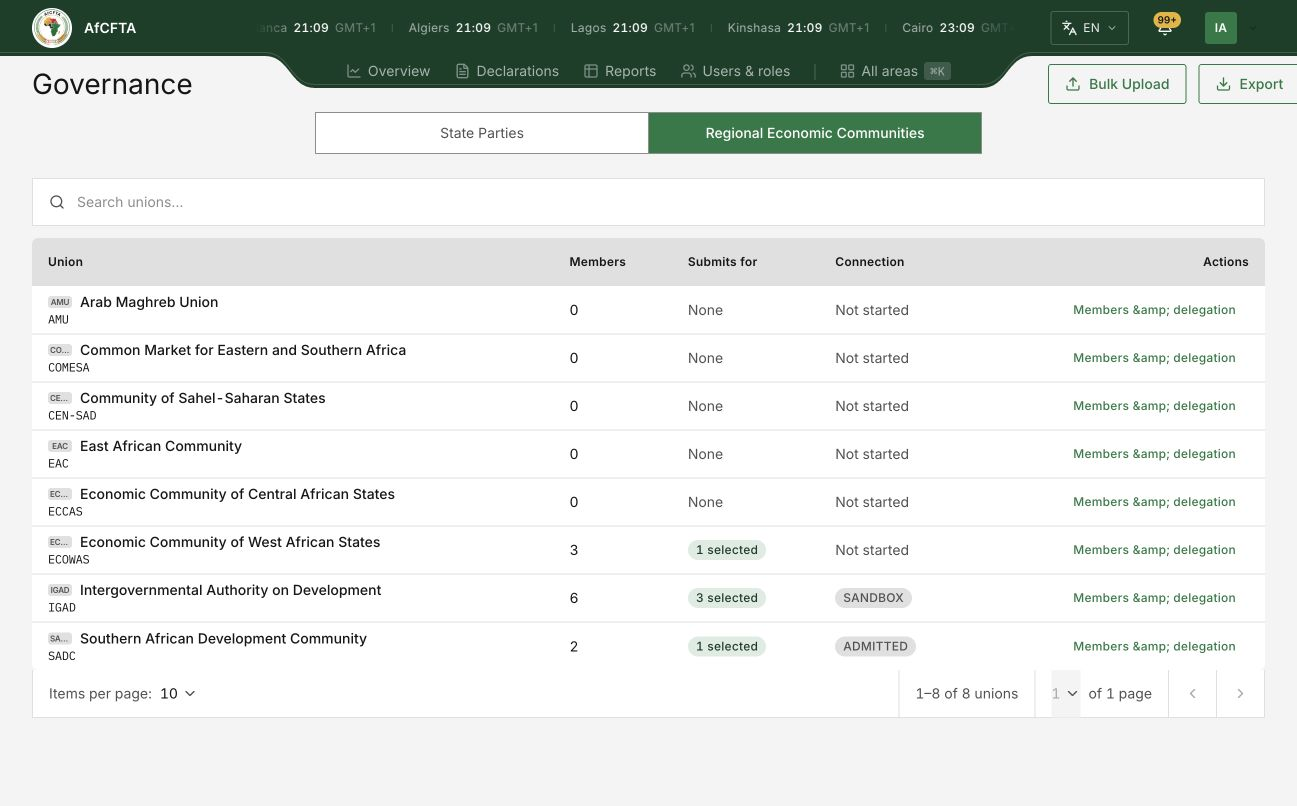
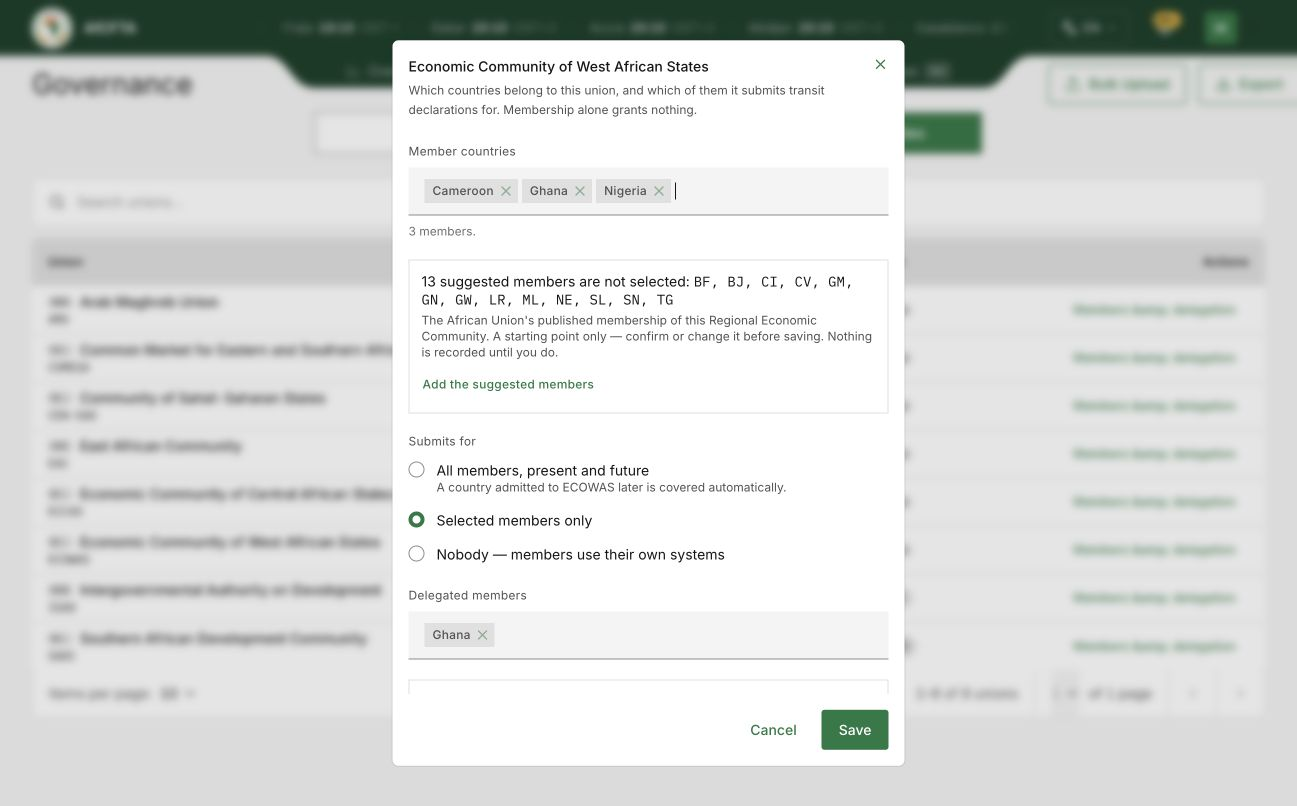
The suggested-members line is the African Union's published list, offered as a starting point. Nothing is recorded until you save, so confirm it rather than accepting it.
It worked when the community's row shows a count under Submits for that matches what you agreed, and each delegated country's own row in the State Parties tab names that community under Submits via.
If a delegation was recorded against the wrong community or the wrong dates, withdraw that arrangement and record a corrected one. Do not edit the membership record to hide it: membership and filing authority answer different questions, and an auditor will ask both.
Check the records before anyone is admitted
A two-minute check that prevents a class of problem which is painful to unwind later.
- For the country about to be admitted, find the record that is active on the admission date, not simply the most recent one.
- Confirm nothing else is active for the same purpose. Two active filing arrangements for one country is a contradiction, and ITS will not resolve it for you.
- Confirm the end date is either genuinely open-ended or a date somebody agreed.
It worked when you can say which single record gives this country its authority on the day it is being admitted. If you cannot, pause the admission and reconcile the dates first.